


If you’re researching ducted air conditioning, you’re probably at one of two points — either you’re building or renovating and want to do it right the first time, or your current system is ageing and you’re finally ready to replace it.
Either way, the questions are the same: How much does it actually cost? What’s involved in installation? And is ducted the right call for your home?
This guide answers all of it — with real numbers, no filler, and everything you need to make a confident decision.
What Is Ducted Air Conditioning and How Does It Work?
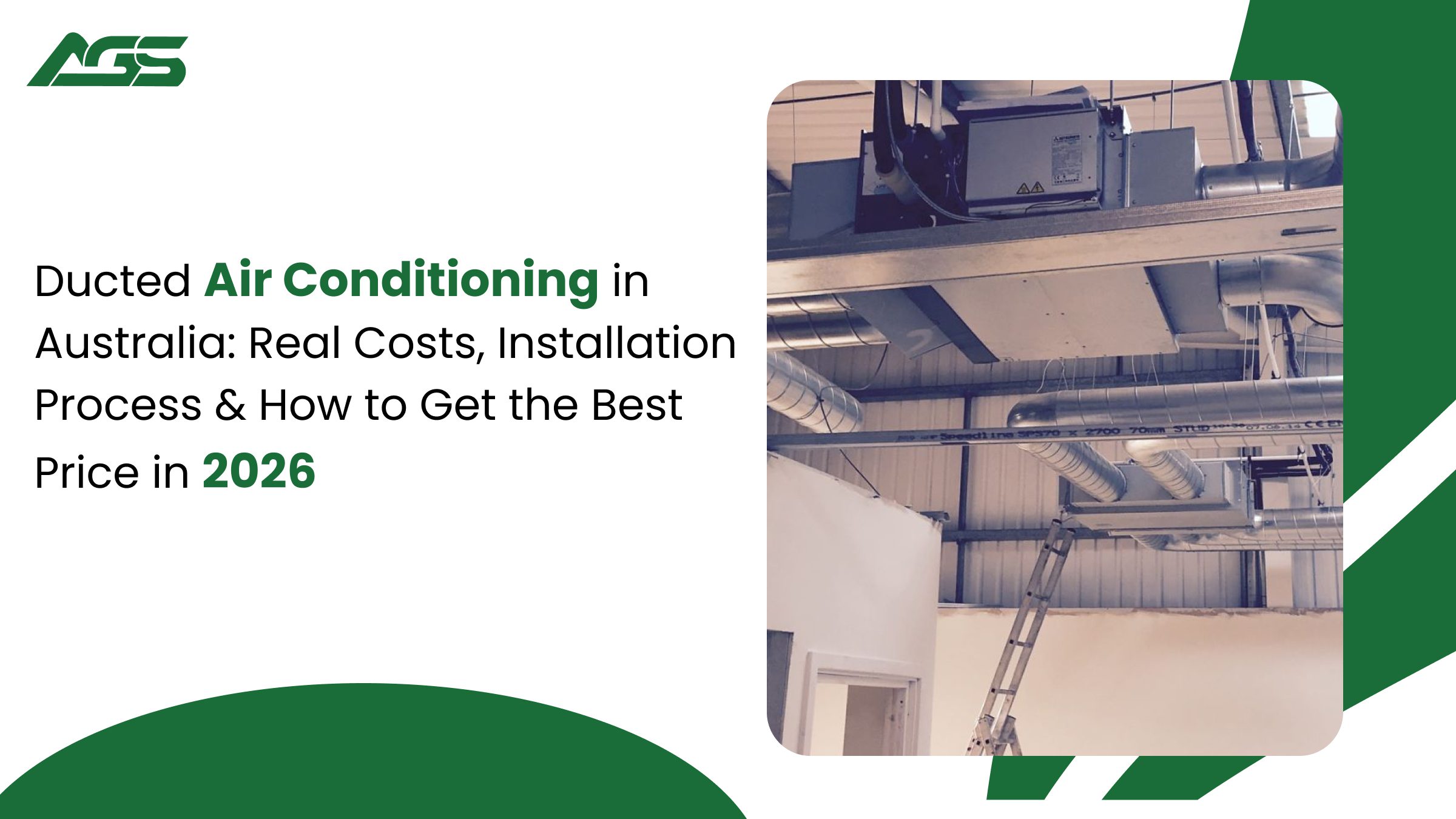
A ducted air conditioning system uses a single central unit — typically installed in your roof cavity or under the floor — to deliver conditioned air to every room in your home through a network of insulated ducts and ceiling vents.
Unlike split systems that have a visible indoor unit mounted on the wall of each room, ducted systems are completely hidden. The only things visible are the vents in your ceiling and a wall controller. The result is whole-home climate control with a clean, uninterrupted interior aesthetic.
The system works in two directions:
- Cooling mode: The central unit extracts heat from indoor air and expels it outside via the outdoor compressor unit
- Heating mode: On reverse cycle models, the process reverses — heat is extracted from outside air and distributed indoors
All ducted systems supplied and installed by Astra Green Solutions are reverse cycle, meaning one system handles both your heating and cooling needs year-round — eliminating the need for a separate gas ducted heating system entirely.
Ducted vs Split System — Which One Do You Actually Need?
This is the most common question, and the answer depends on how many rooms you need to climate control.
| Ducted | Multi Split | |
|---|---|---|
| Zones | Whole home (up to 8+ zones) | 2–5 rooms |
| Aesthetics | Completely hidden | Visible wall units |
| Installation | Requires ceiling cavity | Minimal structural work |
| Best for | Larger homes, new builds, renovations | Medium homes wanting room control |
| Installed cost | $8,000–$18,000+ | $3,500–$8,000 |
| Rebate eligible | ✓ VEU / ESS | ✓ VEU / ESS |
Choose ducted if: You have 4+ rooms to condition, you want a clean finish with no wall units, you’re building new or undertaking a major renovation, or you want to replace both your air conditioning and gas heating with a single system.
Choose multi split if: You only need 2–3 rooms covered and don’t have ceiling cavity access for ductwork.
Reverse Cycle Ducted Air Conditioner — Why It Matters
A reverse cycle ducted air conditioner is the only type worth installing in 2026. Here’s why.
Older ducted systems were cooling-only, meaning homeowners also needed a separate gas ducted heating system running through the same or parallel ductwork. That meant two systems, two sets of maintenance costs, two energy bills, and in many cases, two separate outdoor units competing for space.
A reverse cycle ducted air conditioner does both — and it does them more efficiently than almost any alternative. In heating mode, it extracts heat energy from outside air (even at temperatures as low as -15°C on modern systems) and delivers it indoors. This process uses significantly less energy than gas combustion heating or electric resistance heating.
For homeowners looking at ducted heating system replacement, switching from gas ducted heating to a reverse cycle ducted air conditioner is one of the most financially sound upgrades available right now — particularly with:
- Gas prices continuing to rise across Australia
- Several states progressing toward banning new gas connections in residential builds
- Government rebates actively subsidising the switch to electric heat pump alternatives
Ducted Air Conditioning Cost — Real Numbers for 2026
This is where most guides go vague. Here are actual price ranges based on home size and system complexity.
Supply + Installation Cost by Home Size
| Home Size | System Capacity | Typical Installed Cost |
|---|---|---|
| 2–3 bedroom home | 8–10kW | $8,000 – $11,000 |
| 3–4 bedroom home | 10–14kW | $10,000 – $14,000 |
| 4–5 bedroom home | 14–18kW | $13,000 – $18,000 |
| Large home / commercial | 18kW+ | $18,000+ |
These are supply and installation totals — unit cost plus labour, not one or the other.
What Drives the Cost Up
Several factors can push your quote above the base range:
- Ceiling cavity access: Homes with limited or no roof cavity access (e.g. concrete slab ceilings, low-pitch roofs) require more labour-intensive duct routing
- Number of zones: Each additional zone adds a motorised damper, controller wiring, and commissioning time
- Existing system removal: If replacing an old ducted system, removal and disposal of old equipment adds cost
- Outdoor unit placement: Rooftop or elevated installations require additional mounting hardware and labour
- Electrical upgrades: Older homes may require a board upgrade to handle the additional electrical load of a modern ducted system
What Reduces the Cost
- Government rebates: Eligible Victorian households can access subsidies through the VEU program, NSW homeowners through the Energy Savings Scheme (ESS), and ACT residents through the Sustainable Household Scheme — reducing net out-of-pocket cost by hundreds to over a thousand dollars in some cases
- New build installation: Installing into a new build before plasterboard is up is faster and cheaper than retrofitting into a finished home
- Combining with other upgrades: Some providers offer better pricing when ducted AC is installed alongside a heat pump hot water system or solar
Ducted Air Conditioning Cost Calculator — How to Estimate Your Own
While no online calculator replaces a proper site assessment, here’s how to build a rough estimate before getting quotes:
Step 1 — Calculate your floor area Measure the total floor area of the rooms you want to condition in square metres.
Step 2 — Apply the capacity rule of thumb As a starting point, Australian homes typically need approximately 125–150 watts per square metre of cooling/heating capacity. A 150m² home therefore needs roughly 19–22kW of total system capacity.
Step 3 — Adjust for your conditions Add 10–15% if your home has:
- High ceilings (above 2.7m)
- Significant west or north-facing glass
- Poor insulation or an uninsulated roof
- An open-plan layout with high traffic areas
Subtract 10% if your home has:
- Double glazing
- Good ceiling insulation (R3.5 or above)
- A heavily shaded roof or eaves
Step 4 — Estimate installed cost Use the capacity figure against the cost table above to get a ballpark range.
Step 5 — Get a proper quote Your ballpark estimate is useful for budgeting, but the only reliable figure comes from a site assessment. A reputable installer will measure each room individually, assess ceiling cavity access, check your electrical board, and provide a fully itemised quote.
Ducted Air Conditioning Installation — What Actually Happens
Understanding the installation process helps you plan the disruption and set realistic expectations.
Step 1: Site Assessment (Pre-installation)
A qualified technician visits your property to assess ceiling cavity dimensions, roof pitch, electrical board capacity, optimal outdoor unit placement, and zoning layout. This determines the final system specification and quote.
Step 2: System Design
The installer maps out the duct network — which rooms are included, where supply vents are positioned, how return air is handled, and where the main unit sits in the roof cavity. Zoning configuration is finalised at this stage.
Step 3: Installation Day(s)
- Roof cavity work: The central indoor unit is positioned and secured in the ceiling cavity. Insulated flexible ductwork is run from the unit to each zone’s supply vent locations
- Vent installation: Supply vents and return air grilles are cut into ceilings and fitted with diffusers
- Outdoor unit installation: The compressor is mounted externally on a concrete pad, bracket, or rooftop mounting frame
- Electrical and refrigerant connections: Licensed electrician connects the system to the electrical board; ARC-licensed technician handles all refrigerant lines
- Controller installation: Wall controller is installed and wired; zone dampers are connected
Step 4: Commissioning and Handover
The system is pressure tested, charged with refrigerant, powered up, and each zone is tested individually for airflow and temperature accuracy. The installer walks you through the controller operation before signing off.
How Long Does Installation Take?
| Home Size | Typical Duration |
|---|---|
| 3 bedroom home | 1 full day |
| 4–5 bedroom home | 1.5 – 2 days |
| Large home with complex zoning | 2 – 3 days |
Can Ducted Air Conditioning Be Installed in an Existing Home?
Yes — but it depends on ceiling cavity access. Most single-storey brick or timber-frame homes with a conventional roof pitch have sufficient cavity space for ductwork. Double-storey homes, homes with concrete slab ceilings, or those with very low roof pitches may require alternative approaches such as underfloor ducting or a hybrid ducted and split system solution.
A site assessment from Astra Green Solutions will confirm what’s feasible for your specific property before any commitment is made.
Ducted Split System — Understanding the Terminology
You may have come across the term “ducted split system” and wondered how it differs from a standard ducted system. The answer is: it doesn’t — they refer to the same thing.
The term “split” simply means the system has a separate indoor unit (in the ceiling) and outdoor unit (outside the home) connected by refrigerant lines. This distinguishes it from older packaged or window units where everything was in one box. All modern ducted air conditioning systems are split systems — the terms are interchangeable.
Ducted Heating System Replacement — Is Now the Right Time?
If your current gas ducted heating system is more than 10 years old, you’re likely facing one or more of the following:
- Rising gas bills as the system becomes less efficient with age
- Increasing repair costs as parts become harder to source
- Uneven heating performance across zones
- A system that only heats — providing no cooling solution for summer
Replacing a gas ducted heating system with a reverse cycle ducted air conditioner addresses all of these at once. You get a single system that heats more efficiently than gas, cools your home in summer, and qualifies for government rebates that reduce the upfront cost of replacement.
In Victoria specifically, the VEU program actively incentivises the replacement of gas heating systems with electric alternatives — meaning the timing in 2026 is as good as it’s likely to get before rebate pools reduce further.
How to Choose the Right Ducted Air Conditioning Provider
The system is only as good as the installation. Here’s what to check before committing to any provider:
Licencing: All refrigerant work must be carried out by an ARC-licenced technician. All electrical work must be completed by a licensed electrician. Ask for licence numbers upfront.
Accreditation: To access VEU rebates in Victoria or ESS rebates in NSW, your provider must be accredited under those schemes. Confirm this before signing anything.
Itemised quote: A legitimate quote breaks down the system cost, installation labour, zone configuration, electrical work, and any additional site-specific requirements separately. Bundled quotes with no breakdown are a red flag.
Warranty: Look for a minimum 5-year warranty on the unit and a separate warranty on installation workmanship. Some premium brands offer up to 10 years on the compressor.
After-sales support: Confirm the provider services what they install. You don’t want to chase a third party for warranty claims or maintenance.
Astra Green Solutions meets all of the above criteria — fully licenced, accredited under the VEU and ESS programs, providing itemised quotes and free site assessments across Victoria, New South Wales, and Canberra ACT.
FAQ
How long does a ducted air conditioning system last? A properly maintained ducted system typically lasts 15 to 20 years. Annual professional servicing and regular filter cleaning (every 4–6 weeks during heavy use) are the two biggest factors in maximising lifespan.
Can I get ducted air conditioning in an apartment? Generally no — ducted systems require ceiling cavity space which most apartments don’t have. A multi split or mini VRF system is the better solution for apartment living.
What maintenance does a ducted system require? Filters should be cleaned every 4–6 weeks during use. An annual professional service covering coil cleaning, refrigerant checks, damper testing, and electrical inspection keeps the system running at peak efficiency.
Is ducted air conditioning energy efficient? Modern reverse cycle ducted systems with inverter technology and zoning controls are significantly more energy efficient than older fixed-speed systems. Zoning allows you to only condition the areas of your home in active use, reducing energy consumption substantially.
What’s the difference between zoned and non-zoned ducted? A non-zoned system conditions every room simultaneously regardless of occupancy. A zoned system uses motorised dampers to direct air only to selected zones — dramatically reducing energy waste. Zoning is strongly recommended for any home with 3 or more rooms.
Ready to Get a Quote?
If you’re in Victoria, New South Wales, or Canberra ACT and ready to move forward with ducted air conditioning, Astra Green Solutions offers free site assessments and no-obligation quotes with full rebate eligibility checks included.
